Medical Expert Witness Fees and Retainer Structures
Physicians set expert witness fees freely, with rates varying by specialty and task.

Medical expert witness fees aren't set by a government insurance program, by an insurance table, or by any government schedule. They're set by the physician, in a free market, the same way a lawyer sets an hourly rate or a contractor bids a job. That arrangement makes expert witness work fundamentally different from clinical medicine, where a payer, not the doctor, decides what a visit or procedure is worth. And because the fee-setting is unregulated, it is fully exposed: opposing counsel can ask what an expert charges, courts can question whether the number is reasonable, and under a federal procedural rule governing civil litigation, the expert's written report has to state the compensation paid for the study and the testimony, along with a list of cases the expert testified in over the preceding four years. Nothing about the rate is private. Understanding how that rate gets built, and what it has to cover, matters as much to the physician setting the number as to the attorney who has to budget for it.
Why experts charge differently for different activities
Not all hours in a case carry the same weight. Reading a chart cold and forming a first impression takes a different kind of effort than sitting across from a cross-examining attorney trying to unravel that opinion in front of a jury. A flat hourly rate across every task either shortchanges the high-stakes work or overcharges the routine work, so most experienced experts build a multi-rate schedule instead of a single number.
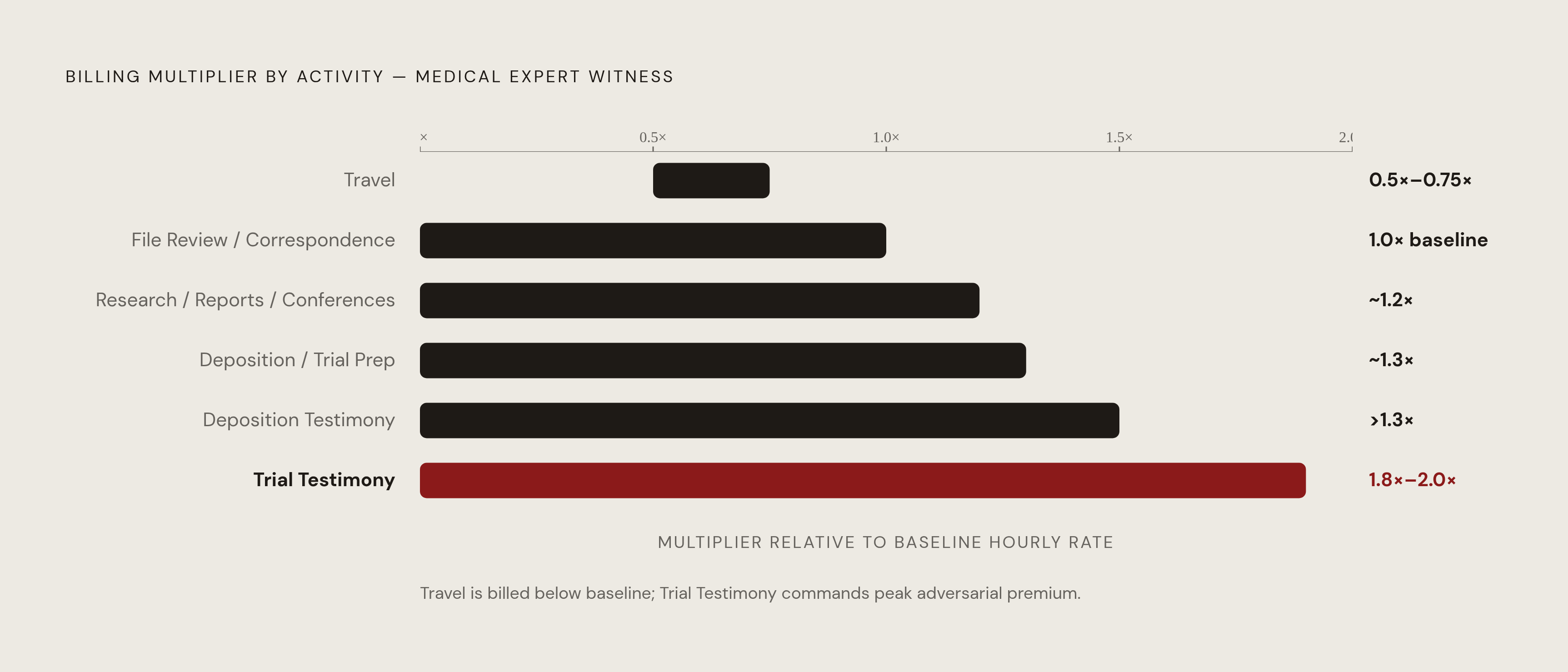
The schedule usually starts with a base rate, most often set for file review or general consulting, and everything else gets priced as a multiple of it. File review and routine correspondence are the baseline, roughly 1.0x. Research, report writing, and case conferences run a bit higher, around 1.2x. Deposition prep and trial prep tend to be near 1.3x. Deposition testimony itself typically climbs meaningfully above prep work, reflecting the adversarial pressure it carries. Trial testimony, the highest-stakes, highest-pressure activity in the whole engagement, commonly runs 1.8x to 2.0x. Travel is the bottom, usually 50% to 75% of the base rate, a range consistent with widely cited industry benchmarks for travel billing. The logic isn't arbitrary: it tracks how much preparation, exposure, and cross-examination risk each task carries.
What the market-wide rate data shows
The Expert Institute has compiled data from more than 100,000 cases, and the topline numbers give a useful anchor for the market as a whole. Across all fields, not just medicine, the average rate for initial case review is around $356 an hour, deposition work averages $448 an hour, and trial testimony averages $478 an hour.
Medical experts sit well above those all-field averages, and the gap isn't small. SEAK's data puts the median file review rate for medical expert witnesses at $350 an hour, about 43% higher than the rate for non-medical experts. Testimony shows an even wider split: medical experts command a median of $500 an hour compared to $275 an hour for experts outside medicine. More recent 2025 survey figures push those numbers higher still, with medical experts averaging $493 an hour for report writing and $597 an hour for testimony. The Physician Side Gigs database, which tracks physician expert rates specifically, finds that most fall somewhere between $350 and $800 an hour, with the exact number driven by specialty, years of experience, and any subspecialty credential the physician holds.
Specialty and credentials that determine where a physician falls in the range
Specialty is the single biggest driver of where a physician lands in that range. At the top, neurosurgery, orthopedic surgery, plastic surgery, and ophthalmology average $850 to $1,525 an hour, a reflection of how technically demanding and high-stakes the underlying cases tend to be. Radiology typically runs $350 to $650 an hour for consulting work, climbing higher for in-court testimony. Orthopedics runs $450 to $900 an hour across initial review and testimony. Psychiatry falls in a $350 to $600 range, depending on how complex the case is and what kind of engagement it calls for. Internal medicine sits lower for routine matters, $300 to $500 an hour, though it climbs for anything unusual. Rare or high-demand subspecialties can push past $1,000 an hour on their own merits.
Among non-surgical specialties, physical medicine and rehabilitation tends to be near or above $550 an hour on average, while emergency medicine, endocrinology, and geriatric medicine are lower, closer to $425 an hour in recent surveys. Layered on top of specialty is the credential itself. A subspecialty certificate, interventional cardiology, maternal-fetal medicine, pediatric neurosurgery, and similar credentials, reliably adds 15% to 40% over the parent specialty's baseline rate. Active, full-time clinical practice commands the top of whatever range applies; a physician working part-time but still current in the field usually sees rates run 5% to 15% lower. Physicians retired for more than three to five years often see a steeper drop, 20% to 30% below the going rate, and they tend to face more pointed challenges from opposing counsel over whether they're still qualified to opine.
Billing for deposition and trial appearances, including minimums and cancellation terms
Testimony is the most expensive line item on any expert's schedule, and the escalation from file review to deposition to trial isn't cosmetic. Each step up demands more preparation and puts the expert directly in an adversarial setting, where the other side's attorney is actively working to undercut the opinion. Pricing reflects that.
Minimum-hour requirements are standard practice. About a third of expert witnesses, 33%, charge a minimum number of hours for deposition testimony, and 31% do the same for trial testimony. A typical deposition minimum requires a set block of hours at the deposition rate, billed in full even if the deposition itself wraps up faster. Trial minimums are usually structured around half-day or full-day blocks. A representative deposition fee structure looks like this: a three-hour minimum, paid in advance, with any time beyond that billed at the hourly rate and paid on the day of the deposition. Scheduling typically requires 50% of the prepayment up front, with the remaining balance due a set number of weeks before the deposition date.
Trial testimony follows a similar logic but scales up. For local appearances, a day rate covers a minimum block of time, paid in advance, with extra hours billed at the standard hourly rate. Out-of-town trial testimony commands a higher day rate and is typically billed portal-to-portal, meaning travel time and waiting time both count toward the bill, not just time spent actually on the stand.
How retainers work
Retainers aren't optional in most engagements; they're the norm. Roughly 74% of expert witnesses require one up front, and the median initial retainer is $2,000 across all fields. For physicians specifically, that figure runs higher, typically $2,500 to $10,000, and it's applied against time as it's earned over the course of the case.
Two structures dominate. The first is the evergreen retainer: the expert draws down against the balance as work gets done, and the attorney agrees to top it back up to keep it funded through the life of the engagement. A common trigger for replenishment is when the balance drops below 20% of the original amount, and the engagement letter should spell out a notice period, typically seven to ten business days, so a replenishment request doesn't land as a surprise mid-case. The second structure is the holding retainer, where the full amount sits untouched until the final invoice is calculated, at which point it's applied and any surplus gets refunded. Holding retainers occur less often in medical expert work; they fit better in short, tightly scoped matters where the scope of work is clear from the outset.
Whether the retainer is refundable matters just as much as which structure is used. A non-refundable retainer, once work has begun, protects the expert if the case settles early or gets abandoned after the initial review is already done, though some payors push back hard on that term. A refundable retainer is easier to sell to a new attorney relationship, but it leaves the expert exposed if the case ends after only light work has been performed. The Physician Side Gigs template specifies the retainer as non-refundable once work has started, a common and defensible position in the industry.
Required contents of a complete fee schedule and engagement letter
Most billing disputes don't come from disagreement over the hourly rate itself. They come from terms nobody wrote down: no stated cancellation policy, a vague travel rate, no defined minimum for a deposition. A fee schedule that leaves those gaps open is inviting a fight later.
A complete schedule spells out the retainer amount and the conditions under which it's refunded, along with hourly rates broken out by activity, document review, case consultation, research, and report writing, each priced separately. Deposition prep, deposition testimony, trial prep, and trial testimony each need their own stated rate, and if teleconference or video testimony is part of the engagement, that needs a rate or policy too. Billing increments should be spelled out, whether that's 15-minute or 30-minute blocks for hourly work, or a three-hour minimum for depositions. Travel time should be priced as a defined percentage of the regular rate, in the 50% to 75% range, with a separate note on whether expenses like flights and hotels are reimbursed at actual cost. Round out the schedule with billing frequency, accepted payment methods, a cancellation policy that names a specific notice window and the fee consequence for missing it, and late payment terms, for instance treating an account as past due at 30 days and applying a monthly late charge from there.
Precision beats a range every time. "File Review: $375/hr; Deposition Testimony: $500/hr" leaves nothing to argue about later; "$300 to $500 an hour depending on the case" leaves an opening for exactly the kind of dispute the schedule is supposed to prevent. The engagement letter is the contract that this schedule lives inside, and it's the first thing an expert can point to when opposing counsel challenges the fee in front of a judge.
The legal and ethical boundaries that govern how fees are set and disclosed
None of this fee-setting happens in a vacuum. A federal procedural rule governing civil litigation requires disclosure as a matter of law, not courtesy: the expert's written report must state the compensation to be paid for the study and the testimony involved in the case. Rule 26(b)(4)(C) goes further, requiring the party who wants to depose the opposing side's expert to pay that expert a reasonable fee for the time spent responding to discovery. Together, these provisions mean an expert's rate isn't a private negotiation between the physician and the retaining attorney; it's a fact of record that opposing counsel gets to see, question, and, if the number looks inflated relative to the market data, challenge in front of the court.